

The Fork - a low end history lesson - part 2





The handoff, the ghost town, and what it means

A public vote, not a handpicked successor: how Anthony Smith stepped back.
Second of two parts on the real split between LowEndTalk (LET) and LowEndSpirit (LES). Part 1 covered why Anthony Smith left LET's admin team and the deliberate founding principles behind LES, privacy, accountability, and no pay-to-post. This part picks up with the 2021 leadership handoff and follows the story through to today: what happened to the community once its founder actually stepped back, twice.
In this part
1. A democratic handoff
2. This won't be my show, it'll be our show
3. Ghost town mode
4. Other forums that tried
5. What any community manager can take from this
6. Appendix, quick reference
A democratic handoff
By late 2020, Anthony Smith was already signaling a plan to step back from LES's admin role, not suddenly, but incrementally, with what he described as "a reset switch should the excrement hit the fan." When Inception Hosting, his hosting business, was sold, that timeline accelerated. His own words on the decision were direct: "Given recent events it is clear to me that I am even less in a position to take this place forward than I was before." He wanted, in his own phrase, to "become as regular a member as possible", a striking goal for a forum's own founder, and a direct rejection of the ownership-as-permanent-control model that had driven the fork from LowEndTalk in the first place.
What happened next is unusually well documented for a community leadership transition: a public nomination and vote thread, open to the whole membership, rather than Anthony Smith simply picking his own successor. He retained only domain-level control as an emergency safeguard, a technical failsafe, not ongoing authority over decisions.
Mason emerged quickly as the clear community favorite. Other members' own words from the thread capture why: one described him as "level-headed and trustworthy," another as a "seasoned campaigner" with real VPS experience who wasn't himself a provider, a detail members explicitly valued, since a provider-admin would reintroduce exactly the conflict-of-interest problem LES had been founded to avoid. Ympker, who received his own nominations, declined and threw his support behind Mason instead, preferring to stay active as a regular member rather than take on an admin role himself, a small, telling echo of Anthony Smith's own stated preference to step back into ordinary membership.
The vote wasn't purely solemn. The thread includes a handful of joking, sarcastic nominations alongside the serious ones, a sign, if anything, of a community comfortable enough with the process to have some fun with it, rather than treating a leadership transition as too fraught for humor. That's its own small data point about the kind of culture the fork had actually produced by 2021: serious about governance, without being humorless about it.
The result was a genuine, community-selected transition, not a founder anointing an heir, and not a hostile takeover, but the specific alternative to both that LES had been built to make possible in the first place.
This won't be my show, it'll be our show

Mason's first act as admin: sharing power with a co-admin.
Mason's introduction thread as LES's new admin, posted in February 2021, is a useful document for anyone thinking about how to actually take over leadership of a community rather than just winning the vote to do it. A five-year member of the LowEnd community, a data analyst and software developer by trade, and the creator of a well-known benchmarking tool in the space, Mason had real standing before the transition, but standing alone doesn't answer the harder question of what kind of leader someone will actually be once they have the role.
His own framing answered it directly:
"This won't be my show, it'll be our show."
>
Mason, on becoming LES's new admin
That's not just a nice line for an introduction post, it committed him, publicly, to a specific governance style before he'd made a single decision as admin: a governance staff body to vote on major calls, rather than one person's unilateral authority. He also committed to an open-door policy, with an explicit line against tolerating personal attacks or racism, while remaining open to constructive criticism, drawing the same kind of clear, principled line LES's concrete, day-to-day moderation always has, now stated in his own voice as the incoming admin.
One decision in that same introduction thread matters more than any other for the specific post you're reading: Mason immediately elevated mikho to equal co-admin status, rather than keeping sole control for himself. His stated reason was direct, mikho "has proven himself to be a valued and knowledgeable member" who brought a hosting-industry perspective Mason himself lacked. That's a leader recognizing a specific gap in his own expertise and choosing to close it by sharing power, rather than trying to fill the gap alone or ignoring it.
Mason also flagged, from the very start, a possible third admin down the line for better timezone coverage, planning for the practical reality of running a global community with a small, volunteer leadership team, rather than assuming two people spread across limited timezones would always be enough. And he explicitly framed the whole effort as continuing Anthony Smith's vision, not replacing it: community-driven development, and the low-end principle of "doing more with less," carried forward rather than reinvented.
Taken together, the introduction thread reads less like a victory lap and more like a job description Mason was writing for himself in public, with the community watching. The next section covers what actually happened once that description met the reality of running a forum over the years that followed.
Ghost town mode

Five quiet years, and an honest admission when the energy ran out.
According to mikho, the co-admin who lived through it directly, the years immediately following the 2021 transition were, in his own words, largely "the same, with little change", a genuine continuity success, exactly what a well-run democratic handoff is supposed to produce. The forum kept functioning, LES's moderation principles kept getting applied the way they'd been designed to, and the community didn't fracture or drift the way a poorly managed leadership change so often causes.
What changed happened later, gradually, and for reasons that had nothing to do with a crisis. Anthony Smith quietly rejoined the LES staff team in February 2026, not as admin, just as staff, his username reverting from a placeholder back to his own name. His own explanation, posted to the forum: he'd stepped away originally over a conflict of interest, which had since ended, and then stayed away longer than planned "due to ongoing health issues." In the years between, he'd been employed rather than running his own company, and by his own account visited LES only infrequently during that stretch, a founder who was, for a while, simply somewhere else, doing something else, on someone else's schedule.
Three months later, on May 2, 2026, Mason and mikho posted together: full admin duties and ownership, handed back to Anthony. Their own words, not softened for this post:
"We simply haven't had the time or energy required to give LES the active management and attention it truly deserves."
>
Mason and mikho, "Returning the Torch"
Five years of keeping the lights on, ad-free and stable, without much active growth, and an open admission of that, in public, by the people who'd done it.
The handback itself started smaller than it sounds. Mason raised it first in a Discord conversation, off the forum entirely. mikho's own account of that moment:
"I had no problems with a hand-over, especially as I had less time to enjoy LES due to my own ventures as owning my own company. It was just a surprise, as I must have misunderstood what he wrote."
>
mikho, on the Discord message that started the handback
He'd read Mason's message as being about bringing Anthony back on for extra help, more hands on deck, not a change of ownership, and only realized later what Mason actually meant. By the time he understood it, he was fine with it: he was running his own company by then too, and had less of his own bandwidth for LES than he'd had in 2021.
It's worth being honest about what can and can't be concluded from this. mikho's account is a firsthand description of a pattern he lived, not a fully diagnosed cause. Communities go quiet for reasons that have nothing to do with leadership, and a founder's return isn't automatically why energy picks back up either. What can be said with more confidence is the shape of the whole arc: five years of stable, careful stewardship, followed by the people doing that stewardship naming their own limits out loud and handing the thing back to the person who built it, not because he took it back, but because they offered.
That's a different kind of ending than the tidy version of this story usually gets told. A "successful" handoff, by the standard metric of "did the new admins keep things running," produced exactly that, and still ended, five years later, with an honest admission that keeping something running and actively growing it aren't the same job, and that recognizing which one you're doing is itself a form of good stewardship.
Other forums that tried

vpsBoard and HostBalls: two other forks, two very different endings.
LowEndSpirit isn't the only attempt to build an alternative home for the budget-hosting community, and two other real cases, researched in enough depth to actually compare, not just name-check, show how differently a fork can end.
vpsBoard launched in October 2013, close to the same year Anthony Smith's original, ultra-budget version of LES got started. Its founder, who went by MannDude, wasn't reacting to a specific governance dispute the way Anthony Smith was. His stated founding motive was almost off-hand, "fueled by tea and general boredom", but the actual design was pointed: explicit provider neutrality, self-hosted infrastructure to avoid third-party tracking, and a strong anti-censorship stance, stated plainly in the forum's own founding post: "we do not resort to the removal, modification or altering of any legitimately posted content." mikho, who was a LowEndTalk member and semi-active on vpsBoard at the time, though his own focus was really the original lowendspirit.com and its $3-or-less VPS niche, where he ran his own budget VPS business, mrvm.net, from 2018 to December 2024, remembers vpsBoard having noticeably less spam and fewer ad-hominem attacks than LET during that period.
It grew fast, by MannDude's own account hitting hundreds of new posts a day at its peak. It shut down in February 2017, and MannDude's stated reasons were mundane rather than dramatic: a software upgrade he found miserable to work with, licensing costs no longer worth renewing, infrastructure spread across more servers than the forum's actual size justified. What wasn't mundane was his stated position on what would happen to the site itself: he refused to sell it or hand it to anyone, citing the privacy risk in trusting someone else with years of user logs.
That stance didn't hold. vpsBoard came back later under KnownHost, a real, established commercial hosting company, the exact kind of outcome MannDude's original refusal was built to prevent. It's technically still online today. Per mikho, it's effectively dead, no real activity, just occasional spam.
HostBalls tells a closer-to-home version of the same underlying story. Its founder, Jarland, had been a LowEndTalk admin himself before leaving, not over a governance dispute, but because a new job came with a non-compete clause. He built HostBalls explicitly as what he called a non-toxic escape from LET, deliberately playing down the commercial deal-posting that dominates both LET and LES. He ran it from 2018 until 2023, when he handed it, voluntarily, not through any acquisition, to a staff member named Wolveix, who still owns and runs it today under an explicit rule: no company or third party has any part in how the forum operates.
One more name on that staff list is worth sitting with: HostBalls had its own admin named Mason from 2018 to 2021, who left after disagreements with Jarland, the same year LowEndSpirit's Mason took the helm there. They're the same person. It's a genuine through-line between these two comparison cases, not a coincidence of a common username: someone who left one fork's leadership after a falling-out went on to run a different, comparable fork carefully and well for the next five years. Line them up and the actual lesson isn't "forking works" or "forking doesn't." It's that a fork's staying power seems to depend less on how justified the original grievance was, and more on what happens to ownership after the founder eventually steps back, a question LES, HostBalls, and vpsBoard each answered differently, with three genuinely different results.
What any community manager can take from this

What any community manager can take from LES's story.
Strip away the specific hosting-industry details, and the LET-to-LES story is a template that recurs across online communities of every kind: a platform's commercial incentives drift away from its members' interests, moderation starts bending around who's paying rather than who's right, a critical mass of trust erodes, and eventually someone with enough credibility and enough of a concrete plan builds an alternative. The specifics of exactly who ran ColoCrossing or what its business relationships looked like matter less to a reader running their own Discord server or subreddit than the underlying pattern does.
The first lesson is structural: examine whose interests your moderation actually protects when they conflict, not just what your rules say on paper. LET's stated rules likely looked reasonable throughout this entire story. What mattered was the pattern of enforcement, whose bans got reversed, and why, which is exactly the kind of thing that's invisible from a rulebook and only visible from the inside, the way it was to Anthony Smith as a volunteer admin watching his own decisions get quietly undone.
The second lesson is about transitions: Anthony Smith's decision to hand LES to a community vote rather than picking his own successor, and his explicit goal of becoming "as regular a member as possible," is a genuinely rare and replicable model. Most founder-led communities either never transition leadership at all, or transition it through private arrangement rather than open process. A public nomination and vote, with the founder retaining only an emergency technical safeguard rather than ongoing authority, is a concrete structure other community builders can copy directly.
The third lesson is the least comfortable: even a well-executed transition doesn't fully dissolve a founder's gravitational pull, as the "ghost town mode" pattern from earlier in this part shows. Planning for that, actively building other sources of community energy and leadership visibility that don't depend on the founder's continued presence, is worth doing deliberately, rather than assuming a formal handoff has fully solved the dependency on its own.
None of this guarantees a fork will succeed, or that forking is even the right response to a given community's problems. Sometimes the better answer really is reform from within. But when reform genuinely isn't available, as it wasn't for Anthony Smith, this post's case shows what a fork built on more than just frustration can actually look like: a specific grievance, a credible founder, a deliberate governance philosophy, and, years later, a real community still standing on the other side of it.
Appendix, quick referencer
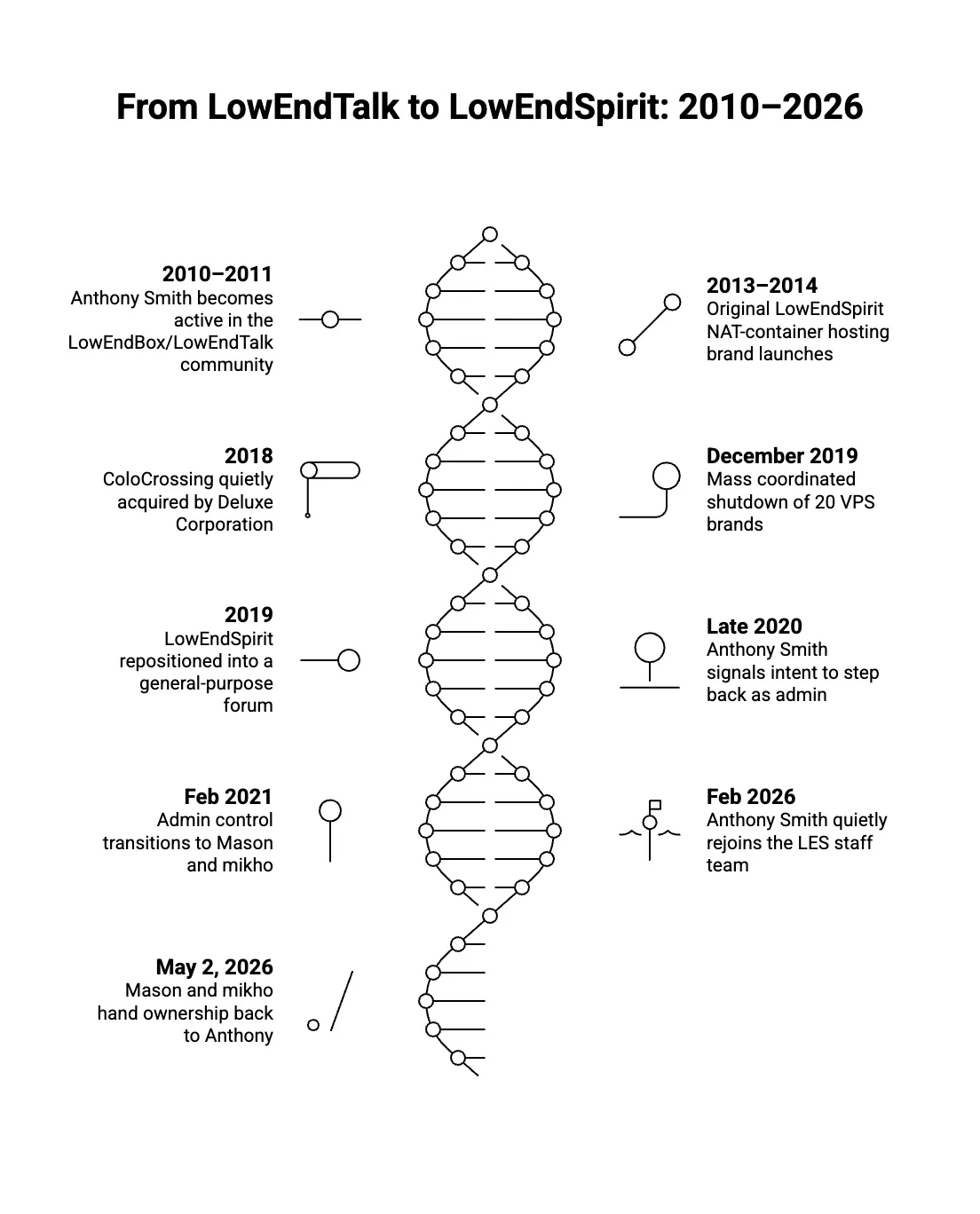
Timeline
- ~2010-2011, Anthony Smith becomes active in the LowEndBox/LowEndTalk community
- ~2013-2014, Original LowEndSpirit NAT-container hosting brand launches
- Volunteer LET admin period, enforcement decisions repeatedly reversed by ColoCrossing leadership
- 2018, ColoCrossing (LET/LEB's owner) quietly acquired by Deluxe Corporation, discovered via an SEC filing
- December 2019, Mass coordinated shutdown of 20 VPS brands, seventeen of eighteen recently featured on the community's own deal-listing site
- 2019, LowEndSpirit repositioned from a niche hosting brand into a general-purpose forum
- Late 2020, Anthony Smith signals intent to step back as admin
- Feb 2021, Public nomination/vote transitions admin control to Mason, who brings on mikho as equal co-admin
- Feb 2026, Anthony Smith quietly rejoins the LES staff team
- May 2, 2026, Mason and mikho hand full admin duties and ownership back to Anthony ("Returning the Torch")
Other forks, for comparison
- Oct 2013, vpsBoard launches (MannDude), on explicit provider-neutral, privacy-first, anti-censorship principles
- Feb 2017, vpsBoard shuts down; founder refuses to sell it or hand it off, citing user-privacy concerns
- 2018, HostBalls launches (Jarland, an ex-LET admin), built as a "non-toxic escape" from LET; Mason is HostBalls admin, 2018-2021
- 2021, Mason leaves HostBalls after disagreements with founder Jarland; becomes LES's admin the same year
- 2023, Jarland voluntarily hands HostBalls to staff member Wolveix, who still solely owns and runs it today
- Later, vpsBoard is relaunched under KnownHost, a commercial hosting company; today it's technically online but effectively inactive
Glossary
- Fork, a community split where a meaningful group leaves to rebuild elsewhere under different governance
- OG tag, status marker for early LET members who migrated to LES
- Provider tag, required disclosure marking an account as a hosting provider before posting offers
- Pay-to-post, LowEndTalk's practice of charging providers to post offers, which LES deliberately does not do
- Deadpool, community slang for a provider vanishing or shutting down, often abruptly (see this series' companion piece, The Deadpool Files)
Comparison: LES vs. LET moderation (as described by LES's own admin and FAQ)
- Ad hominem attacks: actively cleaned up on LES; more tolerated on LET
- Undisclosed provider offers: actively removed on LES via mandatory tagging
- Charging providers to post: practiced on LET; not practiced on LES
- ColoCrossing-affiliated providers: particular ongoing scrutiny on LES
Three forks, three endings
- LowEndSpirit, founder steps back for a community vote, admins later hand it back to the founder by invitation. Continuity preserved throughout.
- HostBalls, founder hands off voluntarily to a trusted staff member after five years; still privately, solely owned, with an explicit no-company-or-third-party rule.
- vpsBoard, founder shuts it down rather than hand it to anyone, citing privacy; it's acquired by a commercial host anyway, years later, and now sits mostly dormant.
Primary sources for readers who want to go deeper
- Anthony Smith's "A year in LES" retrospective
- The 2021 admin nomination/vote thread
- Mason's admin-introduction thread
- The LES "What the FAQ" thread
- Anthony Smith's founding-intent comment on LES's Rules thread
- "A Familiar Face Returns to the LES Staff Team…" (Feb 2026)
- "Returning the Torch, Future of LowEndSpirit" (May 2026)
- "This is vpsBoard", vpsBoard's founding post (2013)
- "vpsBoard's Future", the KnownHost relaunch announcement
- HostBalls' "Welcome to HostBalls" post, including its staff history
Missed part 1? It is available here.
Meet Nix and Bruce @ https://twobirdsonelesbox.com
My project/stuff page @ https://serveraddict.net
Comments
Great write-up - to save things from being forgotten. Thanks.
🔧 BikeGremlin guides & resources
These blog posts are the kind of niche, old-internet feeling stuff that 60 years from now some internet archaeologist will uncover and spend 6 months down a rabbit hole with.
In other words, wonderful.
That's longer than expected, 6 minutes.
Very educative